Oxford Economics’ forecasts help us quantify the impact of new initiatives, stress-test our assumptions, and confidently prioritise investments that support Abu Dhabi’s long-term tourism strategy.
Travel Data & Forecasting
Know Where Your Markets Are Headed Next
From a single country to the entire globe, the Global Travel Service shows where travel demand and spending are moving in the markets you care about, with the global context to understand what’s driving the shift.
Every Country Measures Travel Differently
Where will your markets go next, and why? Simple questions with harder answers. Our economists gather travel data country by country, using different definitions and timelines, so building one comparable, forward-looking view of global demand takes more than pulling the numbers together.
Plan for Where Travel Is Going
One Consistent View of Country-Level Travel Demand
Tourism Economics’ Global Travel Service (GTS) maps source market demand to destinations, the most comprehensive travel dataset of its kind: travel and economic activity for 185 countries, all built on a single, globally consistent methodology. It captures who is traveling where, why they go, how long they stay, how they get there, and what they spend, with nearly 30 years of history and 10-year forward-looking forecasts.
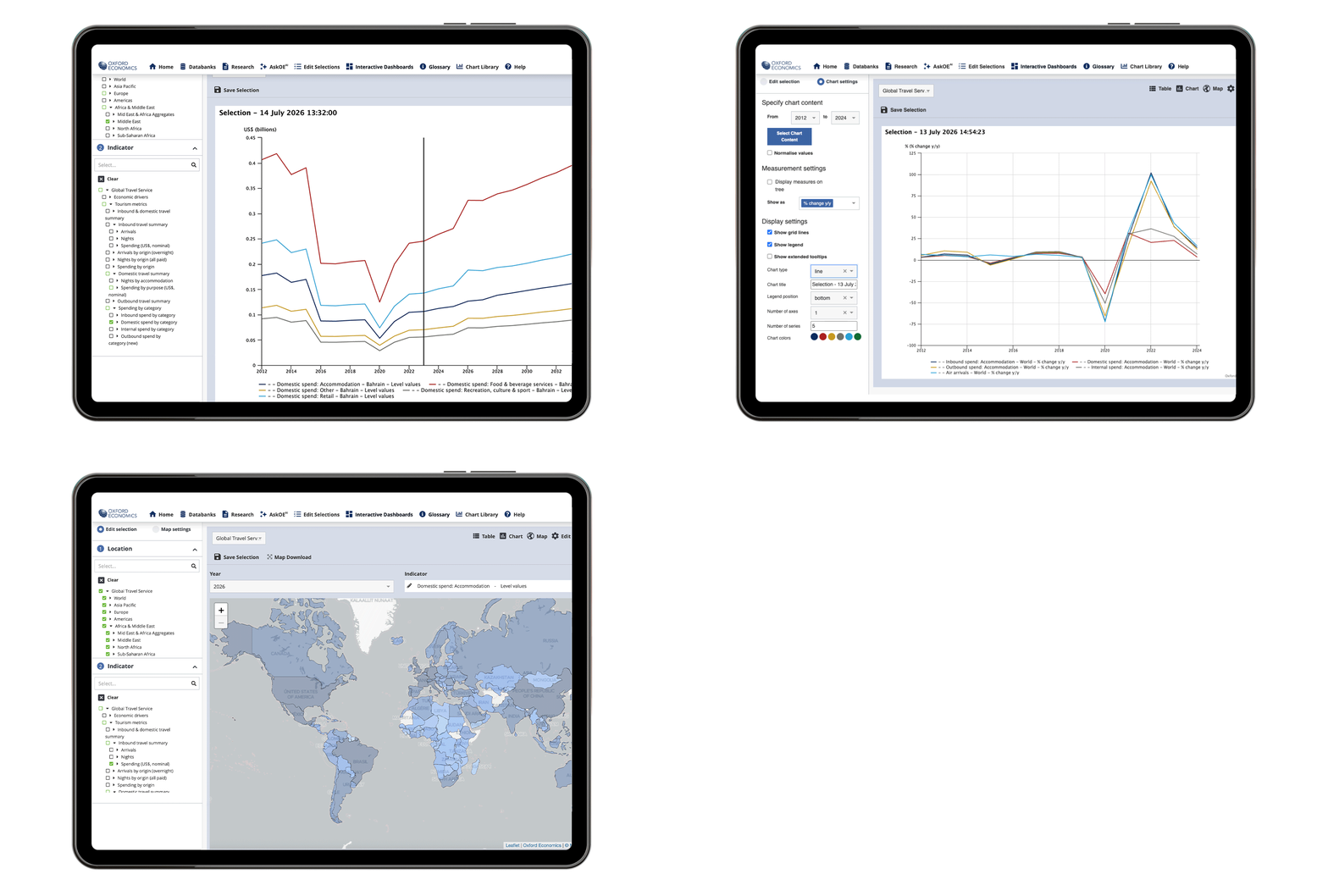
Because every market sits within the same framework, the numbers are directly comparable across countries, origin and destination pairs, and the wider economy. You can move from a global question to a defensible answer in minutes, complete with dynamic tables, charts, and maps.
What you can do:
- Track origin to destination flows: visits, nights, and spending across every major country pair
- Compare markets on a like-for-like basis, from mature destinations to emerging growth markets
- View international arrivals by purpose and origin, nights by domestic vs international, length of stay, spending by category
- Explore ready-made country dashboards with built-in executive summaries, or filter for your own views
For granular data at the city level, explore Global City Travel.

Grounded in Globally Recognized Economic Modeling
GTS forecasts are demand-led, not booking-led, and no destination is considered in isolation. They’re built on the Oxford Economics Global Economic Model, a globally recognized framework used by governments, central banks, and businesses worldwide, so travel projections move in step with the forces that drive them: economic growth, incomes, exchange rates, and demographics.
As an independent, third-party research firm, Tourism Economics has no inventory to sell and no stake in the outcome. Our forecasts reflect the evidence, which is why they hold up in boardrooms, investment committees, and government and media settings alike.
One Dataset, Decisions Across the Travel Economy
Size and Prioritize Markets
Compare demand and spending across 185 countries to focus expansion, marketing, or investment, and spot emerging markets early.
Plan Capacity and Operations
Anticipate visitor volumes, seasonality, and origin mix to plan routes, rooms, staffing, and inventory against demand that’s coming, not demand that’s gone.
Strengthen Strategy & Investment Cases
Bring independent, forward-looking evidence to board decks, feasibility studies, and investor conversations, and sense-check internal forecasts against a trusted benchmark.
Trusted Across the Travel Economy and Beyond
GTS supports any organization whose decisions depend on the movement of people: destinations and tourism boards, airlines and airports, hotels and accommodation groups, retailers and real estate investors, attractions, governments, financial institutions, and travel platforms.

What’s Inside the Service
GTS includes nearly 400,000 indicators of tourism and economic activity for every tourism and economic activity across 185 countries. Coverage includes:
- Visits & nights: International and domestic, by trip purpose, mode of transport, average length of stay, and short, medium, or long haul
- Travel spending: Inbound, outbound, and domestic spending by purpose and category
- Departures: Outbound trips taken from each market
- Origin to destination flows: Visits, nights, and spend across country pairs
- Economic & demographic drivers: GDP, population, incomes, inflation, interest rates, and exchange rates behind the forecast
Plus, access advanced query tools, saved searches, export to Excel and PDF, heat-map visualization, and direct economist support.
Frequently Asked Questions
The Global Travel Service (GTS) is a subscription data and forecasting service covering travel and economic activity for 185 countries. It brings traveler origins and destinations, trip purpose, length of stay, mode of travel, and visitor spending into one interface, with over 30 years of history and 10-year forecasts, all built on a single, globally consistent methodology.
GTS combines official travel statistics with the Oxford Economics Global Economic Model. Rather than relying on a single sample or booking feed, it models demand against the economic drivers behind it. The database is updated quarterly, with interim updates and research briefings when major events reshape the outlook.
GTS forecasts are demand-led. They’re generated within the Oxford Economics global model, so projections reflect growth, incomes, exchange rates, and demographics, not just recent bookings or a partial survey. That makes them forward-looking and consistent across every market, rather than a snapshot of one channel’s activity.
GTS measures country-to-country flows: visits, nights, and spending between major origin and destination pairs. For city-level intelligence, see Global City Travel; for international travel into individual US states, see International State Travel.
Data are often assembled market by market, which makes cross-country comparison difficult and inconsistent. GTS models every country within one framework, integrated with a globally recognized economic model, so the numbers are directly comparable. And because Tourism Economics is an independent research firm, the analysis is unbiased, built to inform decisions rather than to sell inventory.
GTS is used across the travel economy and beyond: destinations and tourism boards, airlines and airports, hotels and accommodation groups, retailers and real estate investors, attractions, governments and associations, financial institutions, and travel technology platforms. Any organization whose decisions depend on the movement of people.