Research Brief
World Cup Bump to Overseas Arrivals and Hotel Performance
Data shows how the 2026 FIFA World Cup translated record attendance into measurable gains for US hotels and international visitation.
September 18, 2026
Updated September 18, 2026The 2026 FIFA World Cup drew 6.8 million attendees across North America, nearly double the previous tournament attendance record (held by the US in 1994). In the US, that activity translated into clear gains for host-market hotels and signs of increased international visitation from countries participating in the tournament.
The boost was particularly visible in hotel performance. On US match dates, hotel room revenue in host markets increased 36.3% year over year, driven largely by higher room rates. Tourism Economics estimates the tournament generated approximately $634 million in incremental hotel room revenue in US host markets on and around match dates, enough to lift annual US RevPAR growth by roughly 0.3%.
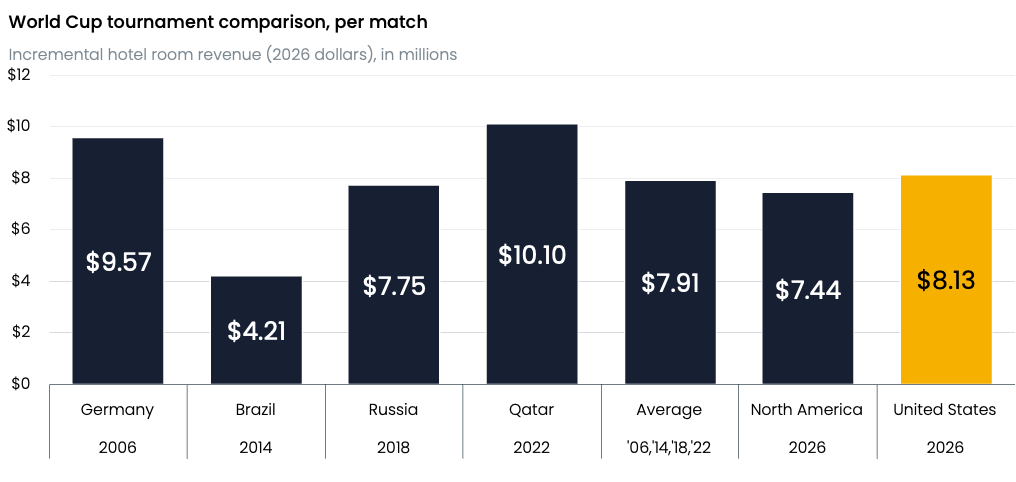
Actual per-match incremental room revenue in the US averaged $8.1 million, slightly ahead of the $7.9 million average generated by prior tournaments.
On a per-match basis, the World Cup impact on US hotels was in line with prior World Cups.
International arrivals tell a more nuanced story. Overall inbound travel remained weak, but countries participating in the World Cup performed materially better than other overseas markets during June and July.
Key findings include:
- Overseas arrivals from participating countries declined just 1.1% year over year in June and July, compared with an 8.9% decline from non-participating countries.
- Arrivals among travelers ages 25 to 44 from participating countries increased 5.7%, consistent with a boost from World Cup fan activity.
- RevPAR grew 14.6% in host markets and 11.3% in adjacent markets, compared with 6.8% in non-host areas during June and July.
- The tournament generated an estimated $633.8 million in incremental hotel room revenue, equivalent to the typical hotel impact of about 6.5 Super Bowls.
- On a per-match basis, US hotel revenue impacts were broadly consistent with those seen during prior World Cups.
The results point to a significant event-driven boost, particularly for hotel pricing and revenue, while also showing the limits of even a mega event in overcoming broader weakness in US inbound travel.
Download the full research briefing for a closer look at tournament attendance, overseas arrival patterns, host-market hotel performance, and how the 2026 results compare with previous World Cups.